Rates, Payments and Claims

To learn how to read your rates notice, click here.
Council rates are a local tax levied on the land value of rateable properties and used to fund services that benefit the general community. The land value is assessed by the Valuer General and Council is currently using valuations with a base date of 1 July 2022.
There are also a range of services for which Council is required to levy a separate charge rather than be funded from rates. This includes, domestic waste management, storm water management, water and sewer supplies.
Rates and charges are listed in the Fees & Charges document at Integrated Planning and Reporting.
RATES
HOW ARE RATES CALCULATED?
The amount of rates raised on your property is determined by the rating category (either residential, business, farmland or mining) and rateable value of your property, the advalorem rate set by Council for that category, and any pension concession you may be eligible for.
The rating category or sub-category is shown on your Rate Notice. If the use of your land changes, or is different to that shown on the Rate Notice, it is your obligation to notify Council of the correct category.
If you do not agree with the category Council has given your land, you or your agent can ask for a review. If you are dissatisfied with Council's declaration of the category of your land after it has been reviewed, or the date the category of your land is to take effect, you may appeal to the Land and Environment Court within 30 days after the declaration is made, under Section 526 of the Local Government Act, 1993.
WHEN ARE RATES DUE?
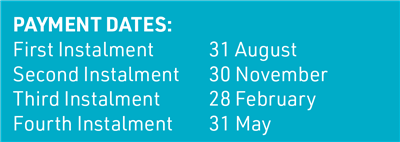
Council rates and charges are due on or before 31 August each year and can also be paid by installments which are payable by 31 August, 30 November, 28 February and 31 May. You will be sent a reminder notice 30 days prior to the due date.
GENERAL REVALUATION
The NSW Valuer General determines and supplies land values to councils to use in setting rates and all councils in NSW receive new land values for rating every three years, this is known as a General Revaluation.
Who determines land values?
The NSW Valuer General determines and supplies land values to councils to use in setting rates.
The NSW Valuer General is:
- An independent statutory officer, appointed by the Governor of NSW, to oversee the land valuation system.
- Responsible for providing fair and consistent land values in NSW, in line with the Valuation of Land Act 1916.
What is a General Revaluation?
All councils in NSW receive new land values for rating every three years. This is known as a General Revaluation.
The land values are for the value of the unimproved land only and reflect the property market value at 1 July 2025.
Council will use the 1 July 2025 land values for rating from 1 July 2026.
How often are land valuations updated?
Revaluations are undertaken by the NSW Valuer General typically every three years.
Why has my land value changed?
Land values can increase or decrease due to factors such as:
- Property sales
- Location and demand
- Zoning changes
- Nearby developments and infrastructure improvements
- Economic conditions
When was I notified of my new land valuation?
The NSW Valuer General issued a Notice of Valuation to property owners advising their land valuation with a base date of 1 July 2025 in early 2026. The notice provided the opportunity to consider your land valuation before Council used it for rating, and provided 60 days to lodge an objection to your land value with Value NSW.
Visit www.nsw.gov.au/valuergeneral to learn more about the review process.
What was the average valuation increase?
The revaluation to a base date of 1 July 2025 has shown that properties in the Dubbo Local Government area have increased by an average 20.55%. Depending on real estate market trends, properties in some parts of the Local Government area increase in land value at a greater rate than others. Some properties land valuations may have increased significantly, while others may have remained unchanged or decreased. Ratepayers can locate their 2022 valuation on their 2025/2026 annual rates and charges notice if they wish to calculate the change in valuation for their property.
How do land values affect Council rates?
Council applies a rate-in-the-dollar to the land value of properties to determine the rates payable by individual properties. This is subject to a minimum amount payable.
A revaluation does not automatically mean everyone’s rates go up. The revaluation updates the relative value of properties across the local government area, which changes how the overall rates burden is shared between ratepayers. The key factor is how your property’s valuation changed compared with other properties in the same rating category or sub-category.
Is Council raising additional revenue through the revaluation?
No. A revaluation does not increase Council’s overall rate income. It simply redistributes how the total rate burden is shared among ratepayers based on updated property values.
Rates are principally calculated by multiplying the land value of a property by a rate-in-the- dollar set for the applicable rating category or sub-category, subject to a minimum amount payable.
Your land valuation is displayed on your Council rate notice, along with the rating category or sub-category assigned to your property.
Council does not receive more rates revenue as a result of land valuations increasing from a General Revaluation. In any year when new valuations apply to a local government area, the rate in the dollar is recalculated in relation to the increase/decrease in land values across the whole of the Council area. All councils in NSW are restricted by legislation, called rate pegging, as to the amount of increase in total rate income that can be applied each year.
What impact does a Revaluation have on rates for individual properties?
The impact of the General Revaluation on the amount of rates levied on individual properties depends on the percentage of valuation change in comparison to the average overall percentage change within the rates category or sub-category in which the property is categorised.
Therefore, if a property in a particular sub-category has changed by close to the average overall percentage for that sub-category, there will be minimal effect on their rates levied for 2026/2027.
Fluctuations in rates occur where the individual valuations increase or decrease outside the average percentage range for their rating category or sub-category.
What is a Rate Peg?
The rate peg determines by how much Council is allowed to raise the total general rates revenue for a given year for the whole of the Local Government Area not individual properties. The rate peg determined by IPART to apply to Dubbo Regional Council in 2026/2027 is 3.0%.
Why did my rates increase by more than the 3% rate peg?
The rate peg determined by IPART to apply to Dubbo Regional Council in 2026/2027 is 3.0%. The rate peg applies to the total general rates revenue generated by Council. The rate peg is not applicable to individual properties. Some ratepayers will see their rates decrease, while others will increase, but the overall Ordinary Rates collected by Council won’t exceed the 3.0% rate peg.
The rate peg is not applicable to Annual Charges.
Does a significant increase in my land value mean my rates will increase by the same percentage?
Not necessarily. Council’s total Rate Yield will increase by 3%. Individual rate assessments may increase or decrease depending on how a property’s valuation changes relative to other properties in their rating category or sub-category.
The new Land Value that applies to any individual property may vary, and in many instances significantly, from the average land value increase of other properties in their rating category or sub-category. This is the reason that individual rates can increase by larger, or smaller, amounts than the rate pegging percentage determined by IPART. This happens every time a new valuation is applied to a Council area.
If all properties in a rating category or subcategory increase by a similar amount, the impact on individual rates may be minimal.
Can my rates go down following a revaluation?
Yes. If your property’s valuation increases by less than the average increase across the rating category or sub-category your property is categorised in, your rates may decrease or increase less than other properties.
My neighbour’s rates changed differently to mine. Why?
Each property is assessed individually.
Changes in rates depend on:
- The property’s land value
- The percentage change in value
- Property classification
- How the property’s value changed compared to other properties
Can Council Change my valuation?
No. Council is required to use the land values supplied by the NSW Valuer General and cannot amend them.
Where can I find my new land value?
Your land value will generally be shown on:
- Your Notice of Valuation issued by NSW Valuer General
- Your Rate Notice
- The NSW Valuer General’s online portal
What if I disagree with my land valuation?
Enquiries regarding the valuation should be directed to the NSW Valuer General. If you do not agree with your property valuation you can ask the NSW Valuer General to review the land value on your Valuation Notice. Please refer to the newsletter from the NSW Valuer General that was included with your Valuation Notice. Please note the 60-day period to lodge an objection has closed. You can find information by visiting www.nsw.gov.au/valuergeneral
If you lodge a valuation objection, you must still pay your rates by the due dates as set out on your 2026/2027 Rate Notice. Failure to pay rates by the required date will result in interest being charged.
If your land valuation has changed, and the amended valuation is not reflected on your 2026/2027 Rate Notice, please contact Council regarding the adjustment required to your 2026/2027 rate levy.
What can I do if I have difficulty paying my rates?
Ratepayers experiencing financial hardship should contact Council as early as possible. Council may be able to assist through:
- Payment arrangements
- Hardship assistance
Where can I get more information?
For valuation enquiries:
Contact Value NSW
For rates enquiries:
Contact Council’s Customer Experience Team
CHARGES
There are a range of services for which Council is required to levy a separate charge rather than be funded from rates. These include:
DOMESTIC WASTE MANAGEMENT
- Domestic waste management - all residential properties within the designated scavenging area are charged either a three bin or a two bin service as defined below:
- Three Bin Service: A once weekly kerbside collection service of one weekly 240 litre food and garden waste green bin, a once weekly kerbside collection of 140 litre garbage red bin and a fortnightly kerbside collection for one 240 litre yellow bin of mixed recycling.
- Two Bin Service: A once weekly kerbside collection service of one weekly kerbside collection of 240 litre garbage red bin and a fortnightly kerbside collection for one 240 litre yellow bin of mixed recycling.
RURAL WASTE MANAGEMENT
A waste management service (rural) charge is applicable to all rural parcels of rateable land with households located within the designated scavenging area applied to those properties for which the service is provided and covers the disposing of small domestic quantities (equivalent to wheelie bin capacity).
The annual charge finances the operation of rural household waste transfer stations and the cost of disposing of small quantities of rural household waste at the Whylandra Waste and Recycling Centre and the Wellington Waste Facility.
VACANT (UNOCCUPIED) LAND WASTE CHARGE
The Local Government Act 1993 requires councils to levy an annual charge for providing domestic waste management services on all parcels of rateable land for which the service is available, whether or not it is actually used. It is considered that all property owners should contribute to the current and future provisions of waste services.
The Vacant Land Rate contributes to the current and future provisions of Councils domestic waste services, such as but not limited to: Waste and Transfer Station Operations, Waste Education, Bulky Waste Collection Service, Plant and Equipment Maintenance and Replacement and Staff Resourcing.
DRAINAGE SERVICE CHARGE
An annual charge which applies to all parcels of rateable land in the 'urban area', levied to raise revenue to fund the upgrade and general maintenance of the stormwater drainage system.
SEWERAGE SERVICE
All Residential properties to which sewerage is available will be levied a Sewerage Service Charge. If the property is the site of a Residential multiple residence property (non strata) the Sewerage Service Charge will be the number of occupancies multiplied by the Residential Sewerage Service Charge x 0.5. Non-Residential properties will be charged a quarterly charge for sewerage service based on usage. Usage will be determined by an assessment of water consumed on the property that is returned to the sewer and will be based on the water consumption.
WATER ACCESS
Levied on all properties to which the service is available, regardless of whether the water is connected to the property or not. The charge is determined by the size of the water meter connected to the property, or, if no meter is connected, the default rate for a 20mm meter is charged.
WATER CONSUMPTION
Water consumption charges are a per kilolitre charge for actual water consumed. A charge is raised for the use of the water supply service on a quarterly basis, for the period indicated in the Water Usage Billing Details section of your rates notice, based on the consumption recorded by the meter or meters servicing each property. Click here to access My DRC Water, the online portal that enables you to monitor your consumption of water anytime, anywhere for free.
SEWER SERVICE CHARGE AND WATER ACCESS CHARGE VACANT BLOCKS
Vacant blocks may have existing infrastructure for future sewer, water and drainage requirements.
All Residential properties to which sewerage is available will be levied a Sewer Service Charge.
Water Access Charges are levied on all properties to which the service is available, regardless of whether the water is connected to the property or not.
The Drainage Service Charges are used to raise revenue to fund the upgrade and general maintenance of the stormwater drainage system.
REBATES
PENSIONER REBATES
Water consumption charges are a per kilolitre charge for actual water consumed. A charge is raised for the use of the water supply service on a quarterly basis based on the consumption recorded by the meter or meters servicing each property.
All NSW Council's give a mandatory rebate of half the General rate up to $250.00, and half the Water Charges and Sewerage Charge up to $87.50 each. The maximum rebate you are eligible for is $425.00 each year.
Council will provide an additional voluntary pensioner rebate to the mandatory pensioner rebate, per household for Water Charges and Sewerage Charge of $12.50 each and for Domestic Waste Management Charges for a three (3) bin service only of $52.
If you are a holder of a current Pensioner Concession Card, and are solely or jointly liable for the rates and charges on the property, which is your principal place of abode, you are eligible for this rebate.
If you start receiving a pension after the commencement of the rating year, you will be eligible for a part year Pension Rebate at the beginning of the next quarter. If you cease to qualify as a pensioner, your pension rebate will be abandoned at the end of the quarterly billing period in which you ceased your entitlement.
To complete the Application for Council Pensioner Concession Rates Rebate form, visit Council's Administration Building in Dubbo or Wellington. The form can also be downloaded here (PDF 336.9KB) (Submission of the form does not automatically confirm your eligibility for this rebate)
Last Edited: 06 Oct 2026